Referee Hands Messi His Yellow and Red Cards as Farewell Gift After Benin Win
Chilean referee Fernando Vejar walked up to Lionel Messi after the final whistle of Argentina's 3-0 farewell win over Benin and handed him the yellow and red cards he had used in the game — a gesture heavy with symbolism, given that Messi's Argentina career began with a red card in 2005.
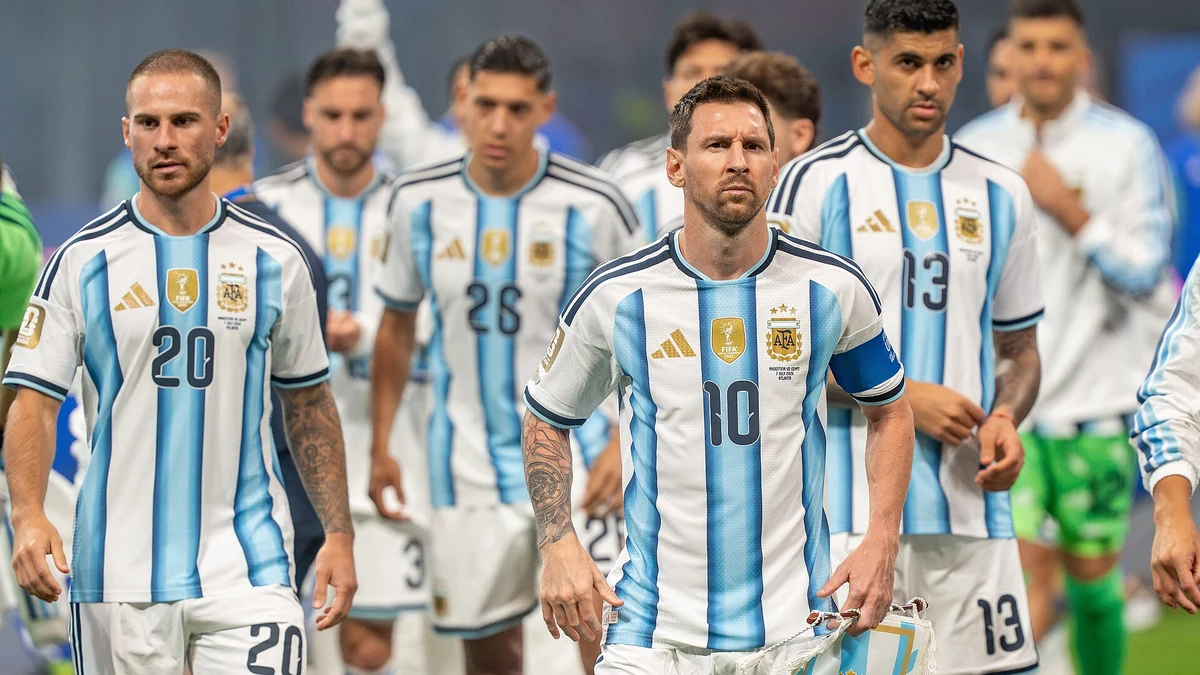
A strange and touching parting gift
The final whistle of Lionel Messi's Argentina career had barely faded when the night produced one more moment nobody in the Estadio Monumental had scripted. Chilean referee Fernando Vejar approached the Argentina captain, greeted him with a warm handshake and a wink, and placed his yellow and red cards into Messi's hands as a personal farewell gift.
The exchange left onlookers stunned. Benin goalkeeper Saturnin Allagbe was seen watching from nearby, visibly bemused, as the referee's plastic cards changed hands on the pitch. This was no disciplinary action — there was no foul, no confrontation, no punishment. It was a deliberate, eccentric memento, offered by an official who had just overseen one of the most emotional nights in Argentine football history.
Argentina had beaten Benin 3-0 in a friendly arranged by the Argentine football federation as a tribute to Messi, who had announced his international retirement in August after the World Cup final defeat to Spain. A sold-out crowd of 85,000 filled the Monumental, almost every shirt in the stands carrying his number 10.
The wink, the handshake, the regift
According to several reports, Vejar's gesture was carefully staged: a handshake, a conspiratorial wink, then the cards. Messi accepted them, but he did not hold on to them for long. Shortly afterwards, Argentine folk singer Soledad Pastorutti — who had performed for the crowd after the match — was seen clutching the official's yellow and red cards, the immediate recipient of Messi's regift.
The moment quickly went viral among fans, with clips of the exchange spreading across social media as supporters tried to work out exactly what they had just witnessed. One viral post summed up the mood perfectly: laughing at the sheer oddity of a referee handing cards to a player as a present, and calling it adorable.
Vejar reportedly added a second keepsake: the match ball, presented to the captain as another souvenir of his 208th and final international appearance. Players from both teams had gathered around Messi on the pitch to congratulate him before the tributes began.
A red card at the start and at the end
The symbolism of Vejar's gift was not lost on anyone who knows Messi's Argentina story. His international career began in disaster: on 17 August 2005, an 18-year-old Messi came on as a substitute against Hungary in Budapest and was sent off by German referee Markus Merk after roughly 47 seconds.
More than 21 years later, a red card was placed in his hands again — but the bookends of his Argentina career could hardly be more different. The first card cut short his debut and left him in tears; the last one arrived as a souvenir, delivered with a wink in front of 85,000 adoring fans. The yellow card, too, became part of the unusual farewell memento.
Fittingly, the farewell night itself echoed the symmetry. The Monumental crowd stopped the match in the 10th minute to applaud him, Benin's players approached him during the tribute to offer their respects, and Messi gave everyone plenty to celebrate on the pitch.
All three goals had his fingerprints
On the field, Messi made sure his final chapter was written the way he wanted. He set up the retiring Nicolas Otamendi early in the second half for the opening goal, laid on Argentina's second for Nico Paz, and then converted a penalty 19 minutes from time to close out the 3-0 win — directly involved in every goal of his farewell.
He nearly had more: a strike against the woodwork and a late free-kick over the bar in the closing minutes. The goal was his 126th in an Argentina shirt, with 70 assists to his name across 208 appearances. The tally cements a legacy that includes the 2021 and 2024 Copa América titles, the 2022 World Cup and the Finalissima.
Addressing the crowd afterwards in a speech that left teammates — most notably Enzo Fernández — in tears, Messi said he was leaving feeling grateful, proud and with a clear conscience. It was a night built around honouring him, and the referee's bizarre gift became one of its most talked-about images.
Why the night mattered so much
The Benin friendly was never really about the result. The Argentine federation had organized it during the October international break as a formal farewell, and the entire evening was choreographed around Messi: the 10th-minute ovation, the video tributes, the post-match concert, the embraces from former teammates.
For the players, the weight of the occasion was visible. Enzo Fernández, who had suffered a red card in the World Cup final defeat to Spain, was among those reduced to tears during Messi's speech. A generation that grew up under the captain's shadow now faces international football without its safety net.
Vejar's gesture — strange, unprecedented, and instantly iconic — captured the spirit of a night when normal rules were suspended. For once, the cards came out after the whistle not to punish a player, but to honour one.
What comes next for Messi
Messi's international career is over, but his football story is not. He remains under contract with Inter Miami, and four nights after the Benin farewell he was back in club action, scoring twice in a 4-0 MLS win over DC United.
The 39-year-old is chasing back-to-back MLS titles with Miami and a third consecutive league MVP award, having already moved to the top of the league's scoring charts. Club football will now carry the full weight of his ambition — and, if the transfer rumours ever settle, a Camp Nou farewell remains the one tribute still missing from his career.
As for the cards, they are no longer his problem. Whether Soledad Pastorutti frames them, auctions them or simply keeps them as a story to tell, they have already become part of the folklore of 6 October 2026 — the night a referee handed cards to Lionel Messi, and everyone knew exactly what it meant.
Questions people ask
Who was the referee who gave Messi the cards?
The match referee, Chilean official Fernando Vejar, walked up to Lionel Messi after the final whistle of the Benin friendly, shook his hand with a smile, and handed over the physical yellow and red cards he had used during the game as a commemorative keepsake.
Why did the referee give Messi the cards?
It was purely symbolic. Messi had not been booked and was not being sent off. Vejar intended the cards as a personal farewell memento, given the poetic link to Messi's first Argentina cap, which ended in a red card after about 47 seconds.
What is the link to Messi's Argentina debut?
On 17 August 2005 in Budapest, Messi came on as an 18-year-old substitute against Hungary and was sent off by Markus Merk barely a minute later. Twenty-one years later, a referee placed a red card in his hands again — this time as a gift at the end of his international journey.
What did Messi do with the cards?
Not for long. Moments after receiving the cards, Messi handed them to Argentine folk singer Soledad Pastorutti, who had performed at the Monumental after the match, turning the referee's souvenir into an instant regift.
Did Messi receive anything else from the referee?
Vejar also gave Messi the match ball, according to multiple reports. Players from both teams gathered around the captain to congratulate him before his emotional farewell speech to the 85,000 crowd.
Find where to watch the Argentina vs Benin Live stream in your country.